






Some fifty years after Bambi was released, Disney did it again—talking animals, instant classic, huge commercial success—but this time with lions. The structure of the film is similar, the first half devoted to Simba’s early childhood, a great tragedy in the middle, then Simba’s journey to adulthood and ascent to his father’s throne. In literature this plot is called a Bildungsroman: a coming of age story.
The Lion King’s script is an original rather than an adaptation. There’s no book behind it, except, at a distance, Felix Salten’s Bambi—and, about as closely, Shakespeare’s Hamlet. The conflict between the original Lion King, Mufasa, and his wicked brother Scar comes straight out of the play, with the added emotional blow to Simba, who is tricked into believing he’s responsible for his father’s death. Only at the end does he learn who really killed Mufasa.
This is Disney, which means the body count is low, the emotional manipulation is high, and the family dynamic is Fifties American. We get a quick nod to the fact that in lion culture the females do the hunting, but we’re still looking at a nuclear family with sweet submissive mom, strong powerful dad-in-charge, and one kid per couple. No multi-cub litters here, and no pride of lionesses keeping their big lazy lion in line.
Of course there’s a (strictly binary and heterosexual) love story. It’s the same one we saw with the deer. Our hero meets the adorable Nala as a child, they fall in love, and eventually there is a new child, a new prince, the circle of life comes back around, cue the award-winning song (music by Elton John, lyrics by Tim Rice).
And of course there’s a large cast of subsidiary animals. The king’s majordomo, Zazu, is a bird. He’s based on the red-billed hornbill, a species native to that part of Africa, and he serves as a guide, a guardian, and an occasional babysitter. He’s more serious than many Disney sidekicks, with a significant role to play in the lions’ kingdom.
On the side of wisecracking cute, we have two animals who befriend the exiled Simba after his father’s death. Timon the meerkat and Pumbaa the warthog are apparently a bonded pair. There’s no warthog herd and no meerkat colony, just the two—buddies? Best friends? Heterosexual life companions?
Whatever they are to each other, they take Simba in hand or hoof or paw and save his life after he’s hit absolute bottom. They get some good songs, including “Wimoweh (The Lion Sleeps Tonight)” and “Hakuna Matata”. They even end up with their own TV series.
The film was only the beginning for this story. Since 1994 there have been a sequel, a prequel, a live-action version with its own prequel/sequel, multiple television series, games, merch, and the third longest-running musical in Broadway history. It’s been a massive moneymaker for Disney.
The story is one of the great archetypes. The chosen child, the fated king, the hero’s journey from infancy through hardship and loss to hard-earned triumph. Simba learns the hard way that you can’t always trust a person or a situation to be what it seems to be. He’s humbled and humiliated; he has to live in exile. But when he’s persuaded to come home, he saves his land and his people from bad leadership and restores the kingdom to peace and prosperity.
It’s not an uncommon story or a rare plot. What makes it so successful is the execution. The mix of characters. The voice acting. The music. The setting.
This is a celebration of Africa. The first words of the theme are in Zulu, and audiences went wild for it (even after they discovered what it actually means). The animals and birds that salute the king at the beginning and the end represent the major species of the region, the ones we all know from zoos and stories. These are not the usual Western-centric places and creatures. They’re outside of the ordinary; they make us pay just a little bit more attention to the familiar tropes.
The lion has a long history in Western European lore and legend. He’s the king of the heraldic animals. It’s not an accident that C.S. Lewis made him an avatar of the Christian Messiah. I would suspect that the writers who created Simba were aware of Aslan and the world of Narnia.
The echoes are strong, whether direct or indirect, and the archetypes run deep. They have power. That power translates into one of the great animated films of our era, and some of the most beloved characters in the genre.

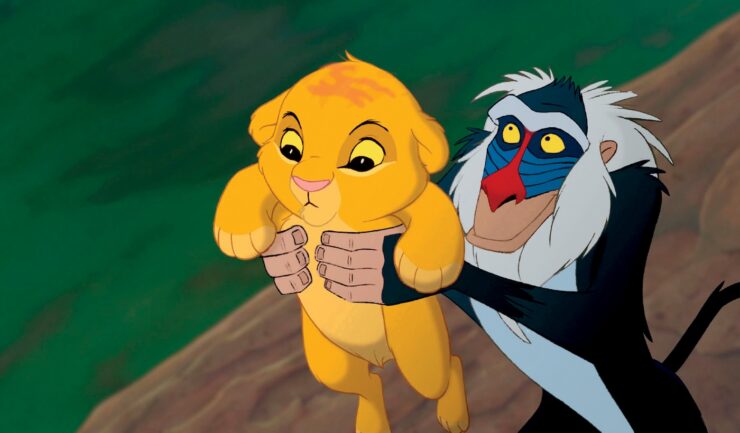
Simba and Nala’s kid who is held up at the end of the film is a girl, right?
As I recall, the film itself doesn’t specify, but the sequel treats the cub as a girl named Kiara.
That I did not know. Awesome!